

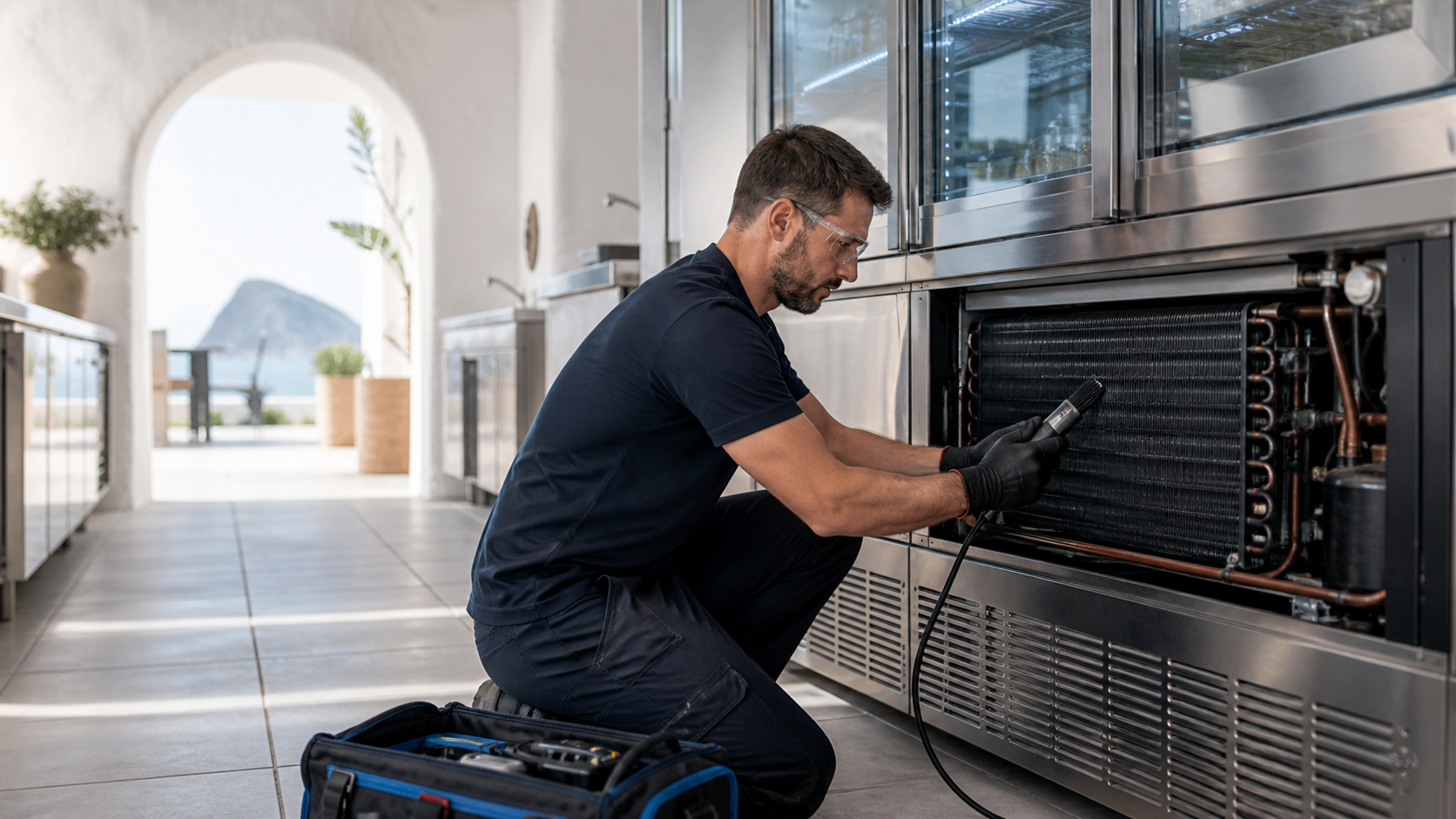
In a restaurant in Ibiza, a cold room cannot allow itself to work at its limit. During the high season, the team endures frequent openings, constant arrivals of goods, a warm atmosphere and long hours. Preventive maintenance of cold rooms helps detect small anomalies before they become a breakdown, service interruption or product loss.
This guide is designed for restaurants, bars, hotels, gourmet stores and other hospitality businesses on the island. The objective is not to replace the intervention of a refrigeration technician, but to help you recognize what to check, what information to prepare and when it is appropriate to request a professional visit.
Why it is advisable to check the refrigeration before the high season
A chamber, display case or bottle rack needs to evacuate heat continuously. If the condenser is dirty, the vent is blocked, or a gasket does not seal properly, the system may work longer to reach expected conditions. That extra effort usually first manifests itself as noise, condensation, irregular frost, or slow recovery after charging.
In Ibiza, in addition, many businesses remain closed for part of the year and put their facilities back into service with little margin. An orderly start-up allows you to check the real status of the equipment, review alarms and plan a repair without waiting for an emergency in the middle of the day.
What does a preventive inspection of cold rooms include?
1. Visual and safety inspection
The first step is to observe the whole: condition of doors, hinges, weather stripping, panels, drains, lighting and grilles. The door should close effortlessly and the weather stripping should support continuously. You must also remove boxes, grease or utensils that prevent air circulation around the equipment.
Before cleaning or opening a panel, personnel must follow the manufacturer's instructions and apply appropriate disconnection measures. The electrical parts and the refrigeration circuit are not areas to improvise.
2. Cleaning the condenser and checking the air flow
The capacitor needs to dissipate heat. The accumulation of dust, grease or lint reduces air exchange and can increase compressor effort. Technical cleaning must be done with the method and products appropriate to the equipment, paying attention to ensuring that the fins are not bent.
It is also advisable to check that the equipment has enough space to ventilate and that it is not directly receiving heat from ovens, irons or very hot areas. In a professional kitchen, the location and cleanliness of the environment have as much influence as the machine itself.
3. Fans, probes and drains
A fan with abnormal noise, vibration or irregular rotation deserves review. Probes and controls must be checked with appropriate instruments and compared with the expected performance of the equipment; An isolated reading on the display does not always explain what is happening inside the camera.
The drainage also requires attention. If the water does not drain correctly, moisture may appear on the floor, ice in unwanted areas or bad odors. It is never advisable to solve a blocked drain by forcing parts or applying products that could damage joints or materials.
4. Doors, joints and usage habits
A hardened seal or a door that remains ajar forces the installation to recover conditions again and again. On a day-to-day basis, it helps to organize the food to reduce openings, not introduce hot foods without judgment and avoid overloading the supply and return grilles.
In display cases, the load must allow air to circulate. A display that is too full may appear operational and yet cool unevenly. The living room and kitchen team should know how to recognize this signal and communicate it before an alarm appears.
Warning signs that should not be ignored
Request a review when you observe one or more of these situations:
- The camera takes longer than usual to recover after charging.
- The compressor runs almost continuously or performs repeated starts.
- There is localized frost, accumulated water or unusual condensation.
- The fan makes a new noise, vibrates, or stops.
- The displayed temperature fluctuates without a clear cause.
- The door does not seal, the weather stripping is deformed or the hinge has moved.
- A recurring alarm appears, although it disappears when restarting.
- There is a smell of an overheated component or an electrical protection is triggered.
If there is a burning smell, electrical damage, visible leak or any risk to people, disconnect the equipment only if it is safe to do so and ask for qualified assistance. Do not handle coolant or protective bridges.
What the person responsible for the business can record
A simple record helps diagnosis. Write down the date, the equipment affected, the incident observed, whether it occurs with or without load and the actions taken by the personnel. It is also useful to keep model references, alarm photographs and repair history.
The Safety Regulation for Refrigeration Facilities establishes safety and maintenance obligations that depend on the type of installation. Therefore, the frequency and scope of a review should not be decided solely by a generic list on the Internet: the equipment, its coolant, its power, its use and the available documentation must be assessed.
Professional maintenance for hospitality in Ibiza
A preventive review allows combining technical cleaning, ventilation check, component inspection, detection of anomalies and recommendations for use. At Aquavila we offer technical service for cold rooms, murals, display cases, bottle racks and other commercial cold systems aimed at hospitality businesses in Ibiza.
The best time to review a facility is usually before the workload reaches its maximum. If your restaurant, hotel or gourmet store is starting the season, gather the information from the team and request an evaluation. A planned intervention makes it easier to decide if maintenance is enough, if a component needs to be repaired or if a replacement should be considered.
Official sources consulted
- Safety regulations for refrigeration installations and complementary technical instructions: Royal Decree 552/2019, consolidated text in the Official State Gazette.
- Regulation of thermal installations in buildings: Royal Decree 1027/2007, when applicable to the installation.
Do you notice that a camera works more, cools unevenly or raises alarms? Contact Aquavila to review your commercial refrigeration system in Ibiza and plan the next step with technical criteria.